Media Kit
Jacob Biamonte
(bee-ah-MON-tay)
Professor, ÉTS Montreal, Université du Québec
MEIE Chairholder in Quantum Computing
Director, ÉTS Institute for Quantum Science and Engineering
The research question
When does a quantum system become a computer?
Or, in Biamonte's own words: "I build and analyze models of computation that lie between efficient classical simulation and universal quantum computation."
Biography
Most discussions of quantum computing focus on how to build the machines. Biamonte asks another fundamental question: what are they actually capable of? This is the question he has pursued throughout his career.
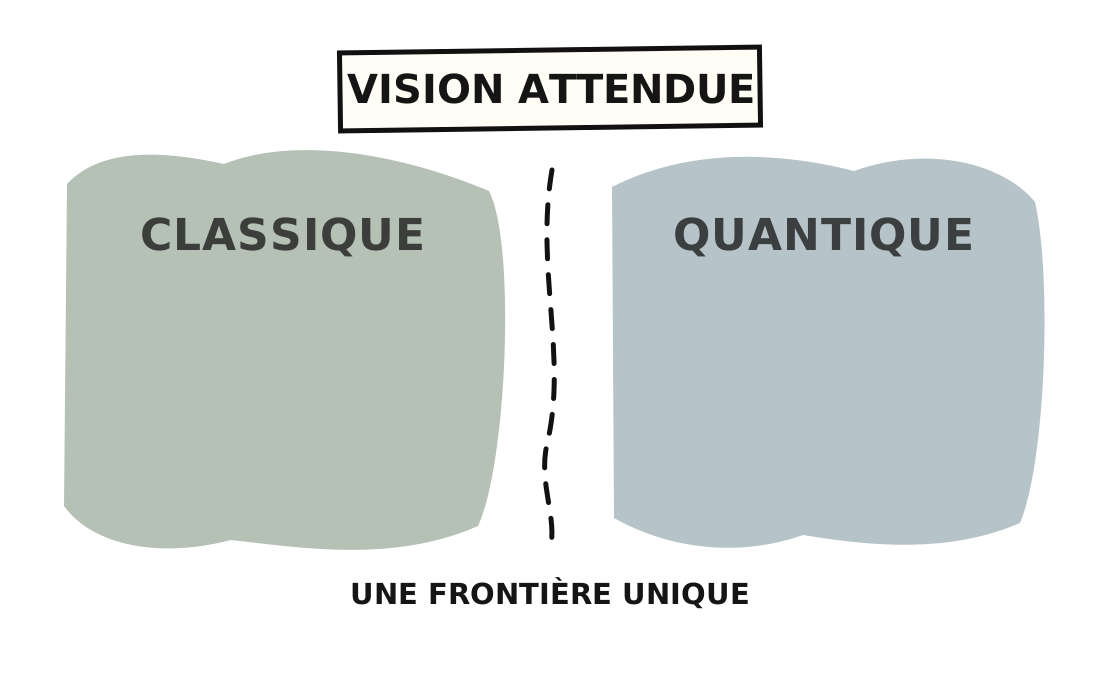
When Biamonte entered the field, quantum computation was often presented as a single sharp divide: classically simulable systems on one side and universal quantum computers on the other. His research instead examines a broader range of computational models, asking which physical and mathematical structures make them difficult to simulate, computationally useful or fully programmable.
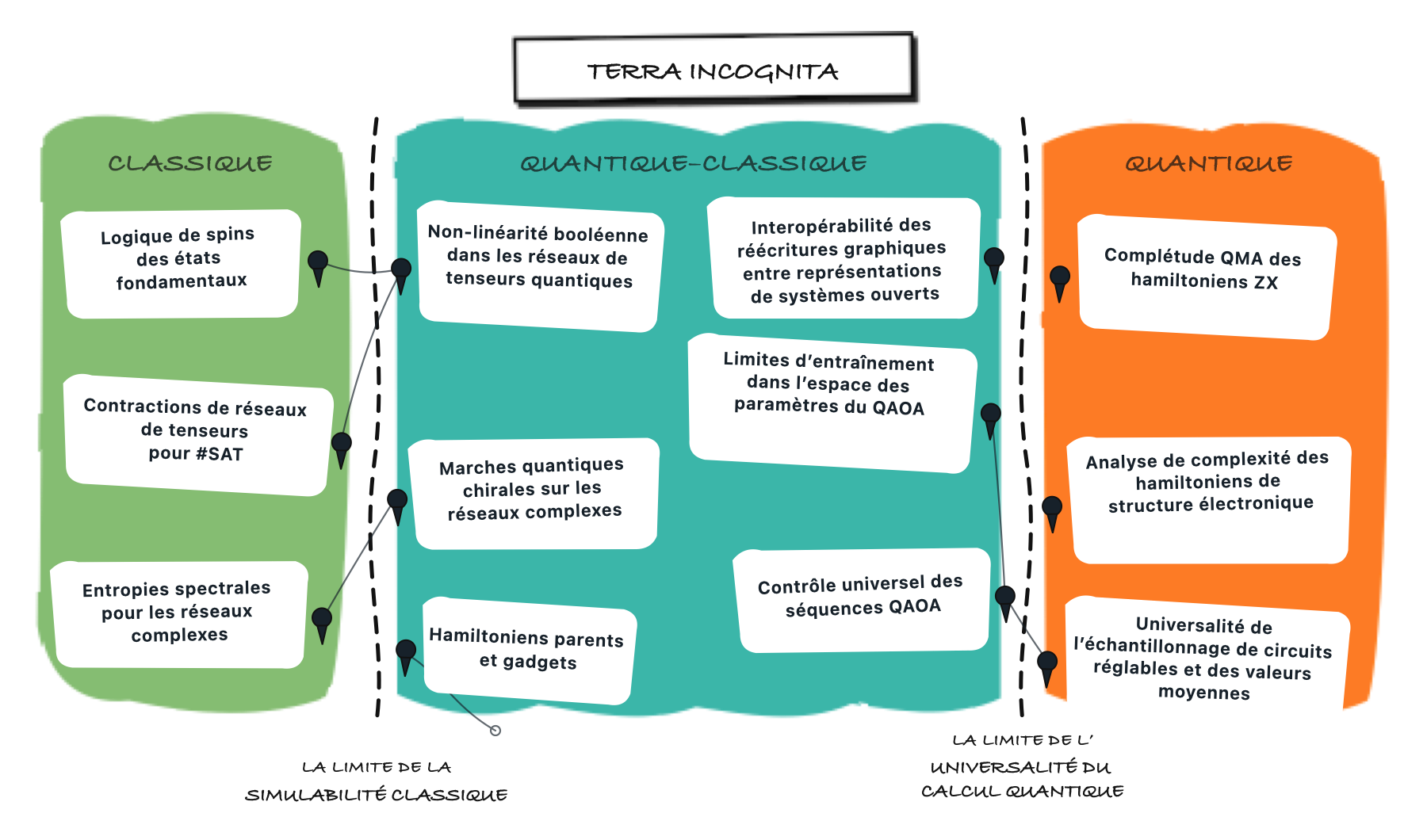
The distinction is not simply between classical and quantum systems. A system can appear intractable to simulate classically without being known to support general-purpose quantum computation; it can also be useful without being fully programmable. Biamonte studies the interactions, composition rules, constraints and feedback mechanisms that distinguish these regimes. In 2008, with Peter Love, he showed that a restricted, experimentally realizable family of ZX interactions can embed universal quantum computation in a system's ground state.
Now Professor at ÉTS, MEIE Chairholder in Quantum Computing, and Director of the ÉTS Institute for Quantum Science and Engineering, Biamonte leads a research program connecting these foundational questions with contemporary quantum hardware. His group studies which systems can be made programmable, what that programmability costs, and how theoretical claims can be tested on real machines.
Areas of work
Four bodies of work, each answering part of the research question.
Conditions for quantum universality
Establishing what it takes for a physical system to support general-purpose quantum computation. Biamonte and Peter Love showed that restricted ZX interactions can embed universal quantum computation in a system's ground state.
Ground-state programming and perturbative gadgets
Developing reusable methods for encoding computation into the ground state of a Hamiltonian. Ground-state spin logic and perturbative gadgets provide systematic ways to encode logical constraints and effective interactions in physical models.
Tensor-network languages and graphical calculi
Developing tensor networks as compositional languages, not only as representations. This work includes the BCJ algebraic normal form and graphical frameworks connecting different representations of open quantum systems.
Classical–quantum feedback
A classical outer loop selects parameters, reads measurements from a parameterized quantum system and determines the next choice. This feedback architecture underlies variational quantum computation and much of quantum machine learning. Biamonte treats the architecture itself as an object of study: his work constructs expected-value objectives that support universal quantum computation and identifies reachability deficits, abrupt training transitions, cost-function locality and layerwise training saturation that limit what such systems can learn or prepare.
Short bios
Please use as written.
One line
Jacob Biamonte's research helps clarify the structural differences between quantum systems that appear intractable to simulate classically yet are not known to support general-purpose quantum computation, and systems that are useful yet not fully programmable.
Short
Jacob Biamonte is Professor at ÉTS Montreal, Université du Québec, and MEIE Chairholder in Quantum Computing. His research helps clarify the structural differences between quantum systems that appear intractable to simulate classically yet are not known to support general-purpose quantum computation, and systems that are useful yet not fully programmable. His contributions include ground-state spin logic, the QMA-completeness of restricted ZX Hamiltonians, chiral quantum walks, fundamental limitations in quantum approximate optimization, and work that helped organize quantum machine learning and quantum complex networks.
Long
Jacob Biamonte is Professor at ÉTS Montreal, Université du Québec, MEIE Chairholder in Quantum Computing, and Director of the ÉTS Institute for Quantum Science and Engineering. His research helps clarify the structural differences between quantum systems that appear intractable to simulate classically yet are not known to support general-purpose quantum computation, and systems that are useful yet not fully programmable. He studies the interactions, compositional rules and mathematical structures that determine what a quantum system can compute. His contributions include ground-state spin logic, the QMA-completeness of restricted ZX Hamiltonians, chiral quantum walks, fundamental limitations in quantum approximate optimization, and work that helped organize quantum machine learning and quantum complex networks. In 2008, with Peter Love, he showed that a restricted, experimentally realizable family of interactions can embed universal quantum computation in a system's ground state. The result is now a Citation Classic.
Quotes
"A quantum system can be intractable to simulate without being useful, and useful without being programmable. I am building a language for the territory in between."
"My work is carving out a language for a new kind of quantum engineering, for example programming languages that control the low-energy states of quantum systems."
"Everything needed to lead quantum computing is already here in Québec: ecosystem expertise and world-class quantum hardware."
"Benchmarking against real physical measurements, rather than only classical simulations, is an important direction for the field." — Chemical & Engineering News, March 2026
At a glance
Current positions
- Professor, ÉTS Montreal, Université du Québec
- MEIE Chairholder in Quantum Computing
- Director, ÉTS Institute for Quantum Science and Engineering
Background
- One of the world's first quantum applications scientists, at D-Wave (2004–2007)
- Two doctorates: computer science (Oxford) and mathematical physics (Doctor of Science higher doctorate, Moscow Institute of Physics and Technology)
Signature contributions
- The 2008 universality result. Realizable Hamiltonians for Universal Adiabatic Quantum Computers, Biamonte and Love, Physical Review A, 2008. Now listed among Citation Classics.
- From theorem to engineering target. The result informed D-Wave's patent family on physical realizations of universal adiabatic quantum computation. Five U.S. grants name Biamonte as an inventor; a related sixth U.S. grant shares the same 2007 provisional priority. The family also includes a Canadian grant and PCT/EU/Japanese filings. Google Patents records 91 families citing the consolidated family, including 52 external to D-Wave. Source: Google Patents, August 2026.
- Universal computation through variational feedback (2021). Two expected-value objective functions show that iterative classical-to-quantum outer-loop optimization can, in principle, prepare the output of an arbitrary quantum circuit.
- Structural limits of feedback-based models. Reachability deficits, abrupt training transitions, cost-function locality and layerwise training saturation help explain why formal universality does not guarantee trainability or useful performance.
- Selected results. Minimal ZX/XZ interactions can embed universal ground-state quantum computation; algebraic tensor-network building blocks can represent arbitrary multiqubit states; the structure of a tensor network can make a hard counting problem tractable; and expected-value objectives establish universal variational quantum computation.
- Field development. Work that helped organize quantum machine learning and quantum complex networks, including Quantum Machine Learning (Nature Perspective, 2017), Tensor Networks in a Nutshell, and Complex Networks from Classical to Quantum, selected for Communications Physics' 2020 anniversary Editor's Highlights.
- Citation impact. Seventeen papers have been cited at least 100 times; seven are in the top 1% of their citation comparison groups, including three in the top 0.1%. Included in the Stanford–Elsevier World's Top 2% Scientists ranking in Physics (2024). Source: OpenAlex, 29 July 2026.
Education
- DPhil, Computer Science, University of Oxford
- Doctor of Science, Mathematical Physics
Selected recognition
- Fellow, Institute of Physics (2023)
- Fellow of the Higher Education Academy (2023)
- Fellow, Institute of Mathematics and its Applications (2021)
- USERN Medal in Formal Sciences (2018)
- EPSRC Doctoral Prize, University of Oxford (2010)
- Trusted Reviewer Award, Journal of Physics A: Mathematical and Theoretical (2020)
Service
- Associate Editor, ACM Transactions on Quantum Computing
- Invited member, Foundational Questions Institute (since 2014)
About the institute
ÉTS recruited Jacob Biamonte in October 2024 to strengthen its quantum-computing research program and international collaborations.
As Director, Biamonte leads the research program of the ÉTS Institute for Quantum Science and Engineering, which pairs foundational research with Québec's quantum processors, industrial partnerships and emerging talent.
Current work
Biamonte and his group investigate where computational structure appears between classical intractability and full programmability. They test these questions on contemporary quantum hardware, probing which systems can be made programmable and what that programmability costs.
Links
- Profile and CV: profs.etsmtl.ca/jbiamonte
- Google Scholar: scholar.google.com
- Key papers:
- Realizable Hamiltonians for Universal Adiabatic Quantum Computers (2008): 10.1103/PhysRevA.78.012352
- Universal Variational Quantum Computation (2021): 10.1103/PhysRevA.103.L030401
- Reachability Deficits in Quantum Approximate Optimization (2020): 10.1103/PhysRevLett.124.090504
- Quantum Machine Learning (Nature, 2017): 10.1038/nature23474
Image library
All images below are free to use with the credit line given. Captions are written to be used as-is. Click an image to open the full-resolution file.
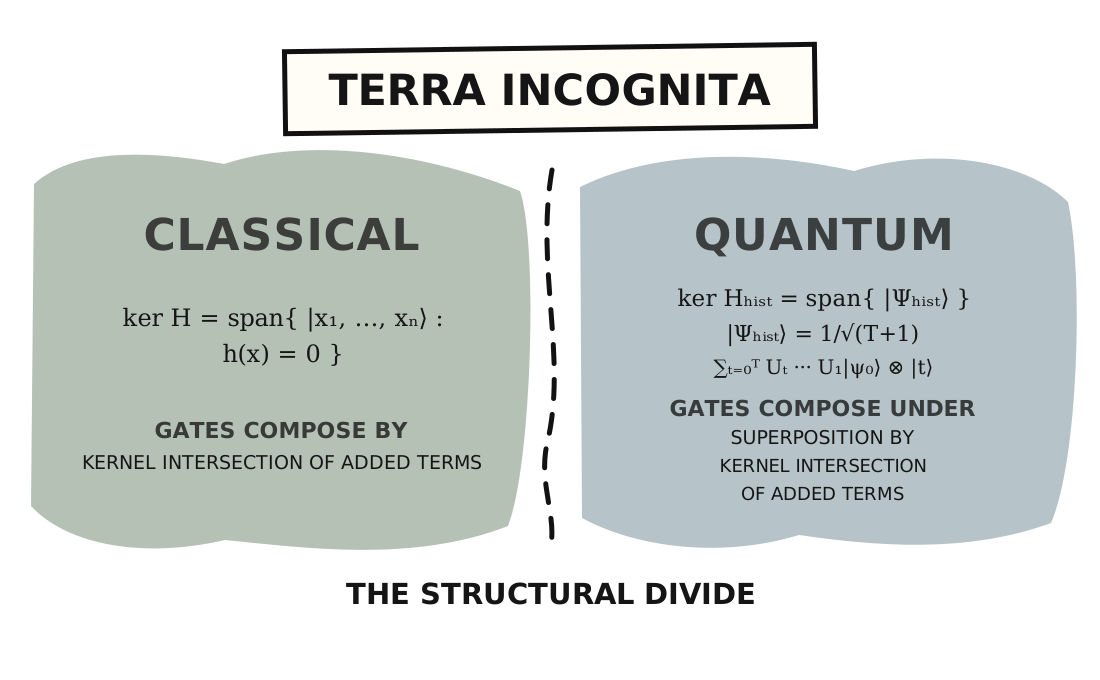
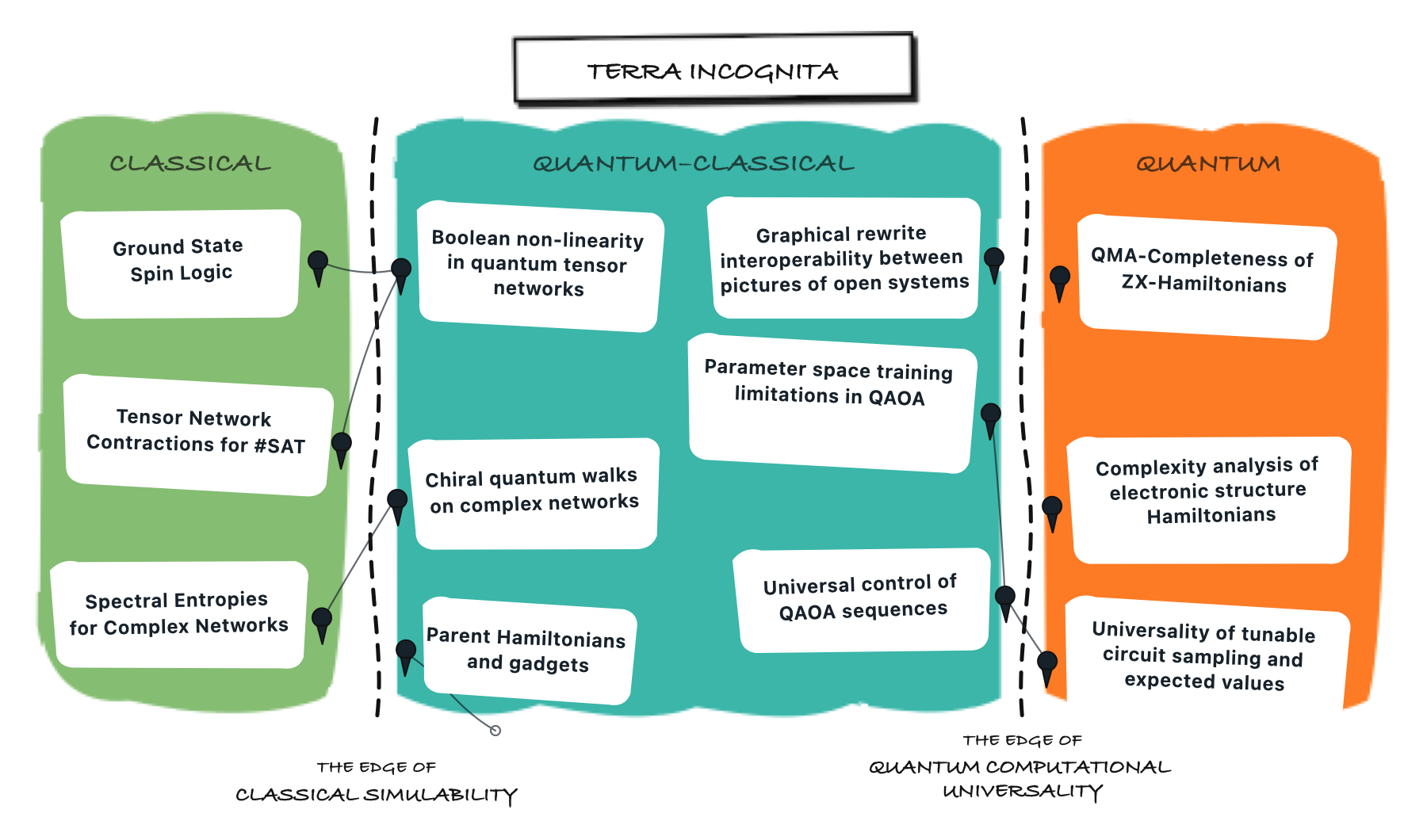
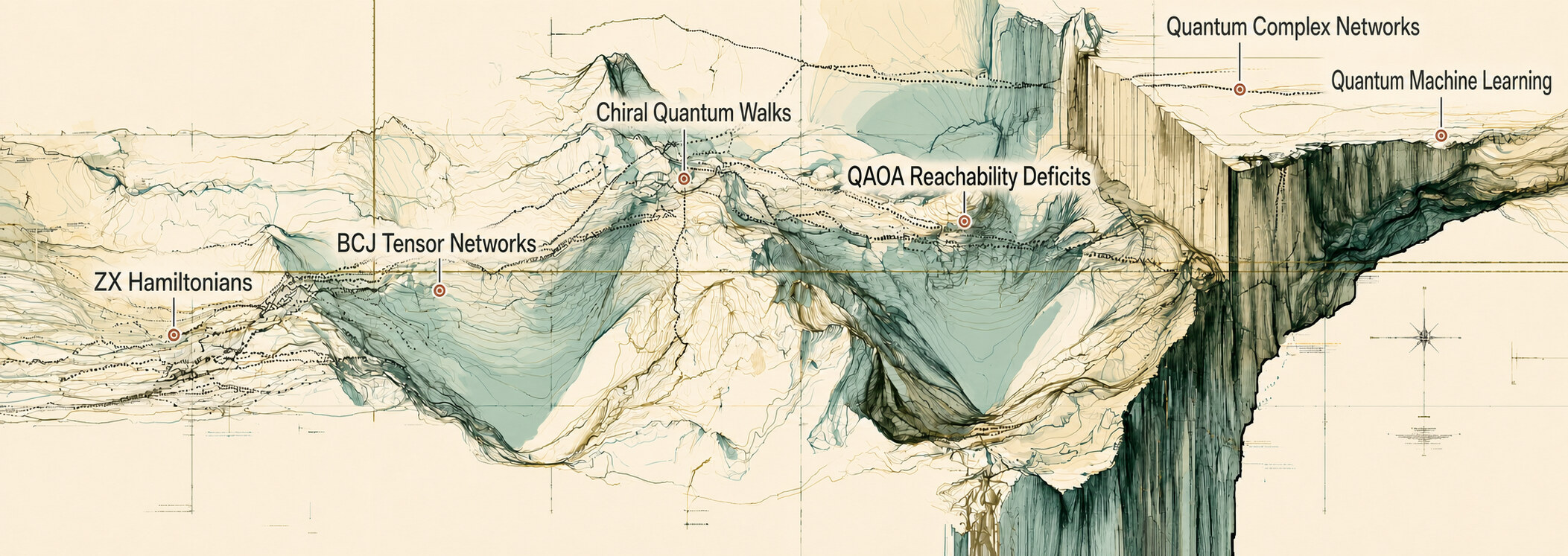
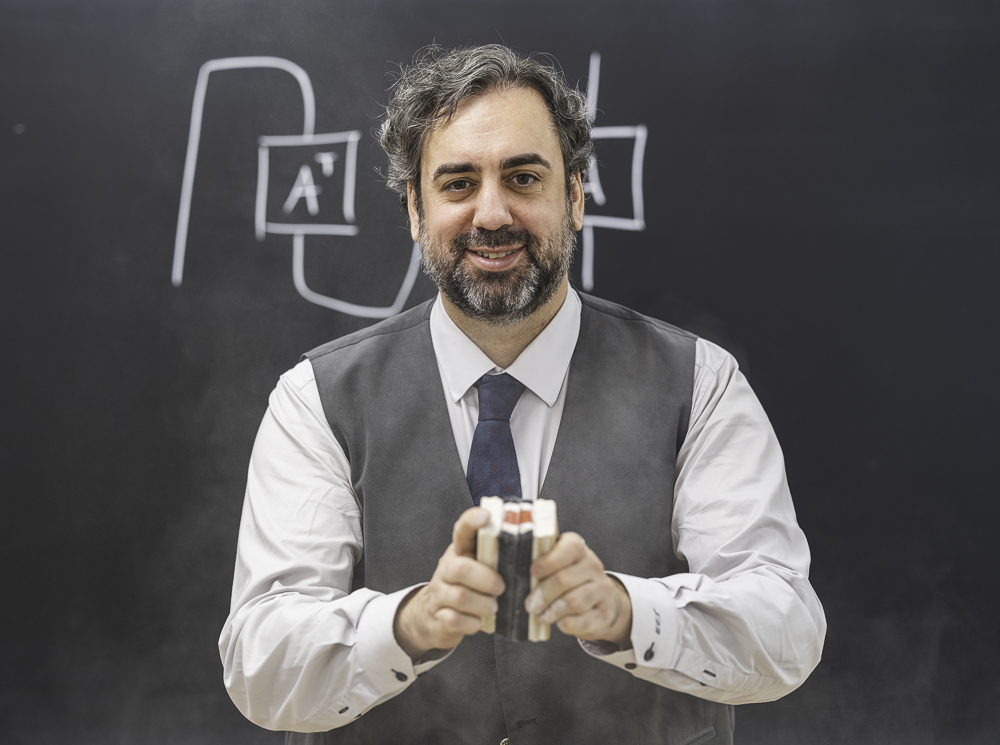
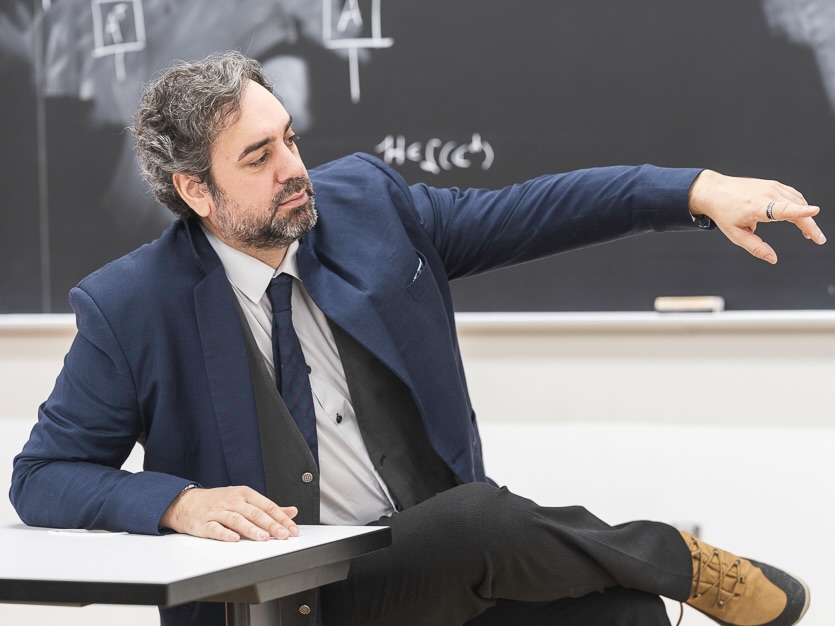



Photo credit: Vincent Lemelin / ÉTS Montréal.
Media contact
Valérie Dubuc
Communications Advisor
ÉTS Montreal, Université du Québec
Montréal, Québec, Canada
Email: communications@etsmtl.ca
Web: etsmtl.ca
Dossier média
Jacob Biamonte
(bee-ah-MON-tay)
Professeur titulaire, École de technologie supérieure (ÉTS), Université du Québec
Titulaire, Chaire principale du MEIE en informatique quantique
Directeur, Institut de science et de génie quantiques de l’ÉTS
La question de recherche
Quand un système quantique devient-il un ordinateur ?
Ou, selon les mots de Biamonte : « Je construis et j’analyse des modèles de calcul situés entre la simulation classique efficace et le calcul quantique universel. »
Biographie
La plupart des discussions sur l’informatique quantique portent sur la façon de construire les machines. Biamonte pose une autre question fondamentale : de quoi sont-elles réellement capables ? C’est la question qu’il poursuit tout au long de sa carrière.
Lorsque Biamonte est entré dans le domaine, le calcul quantique était souvent présenté comme une frontière nette : les systèmes simulables classiquement d’un côté et les ordinateurs quantiques universels de l’autre. Ses recherches examinent plutôt un éventail plus large de modèles de calcul et demandent quelles structures physiques et mathématiques les rendent difficiles à simuler, utiles sur le plan computationnel ou entièrement programmables.
La distinction n’est pas simplement entre les systèmes classiques et quantiques. Un système peut sembler intraitable à simuler classiquement sans être connu pour permettre le calcul quantique généraliste ; il peut aussi être utile sans être entièrement programmable. Biamonte étudie les interactions, les règles de composition, les contraintes et les mécanismes de rétroaction qui distinguent ces régimes. En 2008, avec Peter Love, il a montré qu’une famille restreinte et réalisable expérimentalement d’interactions ZX peut incorporer un calcul quantique universel dans l’état fondamental d’un système.
Aujourd’hui professeur titulaire à l’ÉTS, titulaire de la Chaire principale du MEIE en informatique quantique et directeur de l’Institut de science et de génie quantiques de l’ÉTS, Biamonte dirige un programme de recherche qui relie ces questions fondamentales au matériel quantique contemporain. Son groupe étudie quels systèmes peuvent devenir programmables, le coût de cette programmabilité et la manière de mettre les affirmations théoriques à l’épreuve sur de véritables machines.
Axes de recherche
Quatre ensembles de travaux, chacun répondant à une partie de la question de recherche.
Conditions de l’universalité quantique
Établir ce qu’il faut pour qu’un système physique permette un calcul quantique généraliste. Biamonte et Peter Love ont montré que des interactions ZX restreintes peuvent incorporer un calcul quantique universel dans l’état fondamental d’un système.
Programmation des états fondamentaux et gadgets perturbatifs
Développer des méthodes réutilisables pour encoder un calcul dans l’état fondamental d’un hamiltonien. La logique des états fondamentaux de spin et les gadgets perturbatifs offrent des moyens systématiques d’encoder des contraintes logiques et des interactions effectives dans des modèles physiques.
Langages de réseaux de tenseurs et calculs graphiques
Développer les réseaux de tenseurs comme des langages de composition, et non seulement comme des représentations. Ces travaux comprennent la forme normale algébrique BCJ et des cadres graphiques qui relient différentes représentations des systèmes quantiques ouverts.
Rétroaction classique–quantique
Une boucle externe classique choisit les paramètres, lit les mesures produites par un système quantique paramétré, puis détermine le choix suivant. Cette architecture de rétroaction sous-tend le calcul quantique variationnel et une grande partie de l’apprentissage automatique quantique. Biamonte étudie cette architecture comme un objet à part entière : ses travaux construisent des fonctions objectives fondées sur les valeurs moyennes qui permettent le calcul quantique universel, puis identifient des déficits d’accessibilité, des transitions abruptes de l’entraînement, des effets de localité de la fonction de coût et une saturation couche par couche qui limitent ce que ces systèmes peuvent apprendre ou préparer.
Biographies courtes
À utiliser telles quelles.
Une ligne
Les recherches de Jacob Biamonte contribuent à clarifier les différences structurelles entre les systèmes quantiques dont la simulation classique semble intraitable, mais dont on ne sait pas s’ils permettent un calcul quantique généraliste, et les systèmes qui sont utiles sans être entièrement programmables.
Courte
Jacob Biamonte est professeur titulaire à l’ÉTS, Université du Québec, et titulaire de la Chaire principale du MEIE en informatique quantique. Ses recherches contribuent à clarifier les différences structurelles entre les systèmes quantiques dont la simulation classique semble intraitable, mais dont on ne sait pas s’ils permettent un calcul quantique généraliste, et les systèmes qui sont utiles sans être entièrement programmables. Ses contributions comprennent la logique des états fondamentaux de spin, la QMA-complétude des hamiltoniens ZX restreints, les marches quantiques chirales, les limites fondamentales de l’optimisation quantique approchée, ainsi que des travaux qui ont contribué à structurer l’apprentissage automatique quantique et les réseaux complexes quantiques.
Longue
Jacob Biamonte est professeur titulaire à l’ÉTS, Université du Québec, titulaire de la Chaire principale du MEIE en informatique quantique et directeur de l’Institut de science et de génie quantiques de l’ÉTS. Ses recherches contribuent à clarifier les différences structurelles entre les systèmes quantiques dont la simulation classique semble intraitable, mais dont on ne sait pas s’ils permettent un calcul quantique généraliste, et les systèmes qui sont utiles sans être entièrement programmables. Il étudie les interactions, les règles de composition et les structures mathématiques qui déterminent ce qu’un système quantique peut calculer. Ses contributions comprennent la logique des états fondamentaux de spin, la QMA-complétude des hamiltoniens ZX restreints, les marches quantiques chirales, les limites fondamentales de l’optimisation quantique approchée, ainsi que des travaux qui ont contribué à structurer l’apprentissage automatique quantique et les réseaux complexes quantiques. En 2008, avec Peter Love, il a montré qu’une famille restreinte d’interactions réalisables expérimentalement peut incorporer un calcul quantique universel dans l’état fondamental d’un système. Ce résultat est aujourd’hui un Citation Classic.
Citations
« Un système quantique peut être trop complexe pour être simulé efficacement sans être utile, et utile sans être programmable. Je construis un langage pour le territoire qui s’étend entre les deux. »
« Mes travaux façonnent un langage pour une nouvelle forme d’ingénierie quantique, par exemple des langages de programmation qui contrôlent les états de basse énergie des systèmes quantiques. »
« Tout ce qu’il faut pour mener le calcul quantique se trouve déjà au Québec : l’expertise de l’écosystème et du matériel quantique de classe mondiale. »
« La comparaison avec de véritables mesures physiques, plutôt qu’avec les seules simulations classiques, constitue une orientation importante pour le domaine. » — Chemical & Engineering News, mars 2026, traduction
En bref
Fonctions actuelles
- Professeur titulaire, École de technologie supérieure (ÉTS), Université du Québec
- Titulaire, Chaire principale du MEIE en informatique quantique
- Directeur, Institut de science et de génie quantiques de l’ÉTS
Parcours
- L’un des tout premiers scientifiques au monde spécialisés dans les applications quantiques, chez D-Wave (2004–2007)
- Deux doctorats : informatique (Oxford) et physique mathématique (doctorat supérieur ès sciences, Institut de physique et de technologie de Moscou)
Contributions marquantes
- Le résultat d’universalité de 2008. Realizable Hamiltonians for Universal Adiabatic Quantum Computers, Biamonte et Love, Physical Review A, 2008. Aujourd’hui classé parmi les Citation Classics.
- Du théorème à la cible d’ingénierie. Le résultat a éclairé la famille de brevets de D-Wave consacrée aux réalisations physiques du calcul quantique adiabatique universel. Cinq brevets américains nomment Biamonte comme inventeur ; un sixième brevet américain apparenté revendique la même priorité provisoire de 2007. La famille comprend aussi un brevet canadien et des dépôts PCT, européens et japonais. Google Patents recense 91 familles citant la famille consolidée, dont 52 externes à D-Wave. Source : Google Patents, août 2026.
- Calcul universel par rétroaction variationnelle (2021). Deux fonctions objectives fondées sur les valeurs moyennes montrent qu’une optimisation itérative en boucle externe classique–quantique peut, en principe, préparer la sortie d’un circuit quantique arbitraire.
- Limites structurelles des modèles fondés sur la rétroaction. Les déficits d’accessibilité, les transitions abruptes de l’entraînement, la localité de la fonction de coût et la saturation couche par couche contribuent à expliquer pourquoi l’universalité formelle ne garantit ni l’entraînabilité ni des performances utiles.
- Résultats sélectionnés. Des interactions minimales ZX/XZ peuvent incorporer le calcul quantique universel par état fondamental ; des éléments algébriques de réseaux de tenseurs peuvent représenter des états multiqubits arbitraires ; la structure d’un réseau de tenseurs peut rendre traitable un problème de comptage difficile ; et des objectifs fondés sur les valeurs moyennes établissent le calcul quantique variationnel universel.
- Développement du domaine. Des travaux qui ont contribué à structurer l’apprentissage automatique quantique et les réseaux complexes quantiques, notamment Quantum Machine Learning (Perspective de Nature, 2017), Tensor Networks in a Nutshell et Complex Networks from Classical to Quantum, sélectionné pour les faits saillants du 2020 Anniversary Editors’ Highlights de Communications Physics.
- Impact des citations. Dix-sept articles ont été cités au moins 100 fois ; sept se situent dans le premier 1 % de leur groupe de comparaison de citations, dont trois dans le premier 0,1 %. Inclus dans le classement Stanford–Elsevier des 2 % de scientifiques les plus cités au monde en physique (2024). Source : OpenAlex, 29 juillet 2026.
Formation
- DPhil en informatique, Université d’Oxford
- Doctorat supérieur ès sciences en physique mathématique
Distinctions sélectionnées
- Fellow de l’Institute of Physics (2023)
- Fellow de la Higher Education Academy (2023)
- Fellow de l’Institute of Mathematics and its Applications (2021)
- Médaille USERN en sciences formelles (2018)
- Prix doctoral de l’EPSRC, Université d’Oxford (2010)
- Trusted Reviewer Award, Journal of Physics A: Mathematical and Theoretical (2020)
Service
- Éditeur associé, ACM Transactions on Quantum Computing
- Membre invité, Foundational Questions Institute (depuis 2014)
À propos de l’Institut
L’ÉTS a recruté Jacob Biamonte en octobre 2024 afin de renforcer son programme de recherche en informatique quantique et ses collaborations internationales.
À titre de directeur, Biamonte dirige le programme de recherche de l’Institut de science et de génie quantiques de l’ÉTS, qui associe recherche fondamentale, processeurs quantiques du Québec, partenariats industriels et talents émergents.
Travaux actuels
Biamonte et son groupe étudient où apparaît la structure computationnelle entre l’intraitabilité classique et la programmabilité complète. Ils mettent ces questions à l’épreuve sur du matériel quantique contemporain afin de déterminer quels systèmes peuvent devenir programmables et le coût de cette programmabilité.
Liens
- Profil et CV : profs.etsmtl.ca/jbiamonte
- Google Scholar : scholar.google.com
- Articles clés :
- Realizable Hamiltonians for Universal Adiabatic Quantum Computers (2008) : 10.1103/PhysRevA.78.012352
- Universal Variational Quantum Computation (2021) : 10.1103/PhysRevA.103.L030401
- Reachability Deficits in Quantum Approximate Optimization (2020) : 10.1103/PhysRevLett.124.090504
- Quantum Machine Learning (Nature, 2017) : 10.1038/nature23474
Photothèque
Toutes les images ci-dessous peuvent être utilisées librement avec la mention de crédit indiquée. Les légendes sont prêtes à l’emploi. Cliquez sur une image pour ouvrir le fichier en pleine résolution.
Crédit photo : Vincent Lemelin / ÉTS Montréal.
Contact média
Valérie Dubuc
Conseillère en communication
ÉTS Montreal, Université du Québec
Montréal (Québec), Canada
Courriel : communications@etsmtl.ca
Web : etsmtl.ca