DCCVT: Differentiable Clipped Centroidal Voronoi Tessellation
Wylliam Cantin Charawi, École de Technologie Supérieure
Adrien Gruson, École de Technologie Supérieure
Jane Wu, Standford
Christian Desrosiers, École de Technologie Supérieure
Diego Thomas, Kyushu University
In 3DV, 2026.
Abstract
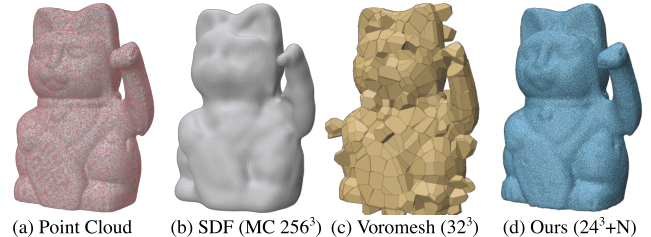
While Marching Cubes (MC) and Marching Tetrahedra (MTet) are widely adopted in 3D reconstruction pipelines due to their simplicity and efficiency, their differentiable variants remain suboptimal for mesh extraction. This often limits the quality of 3D meshes reconstructed from point clouds or images in learning-based frameworks. In contrast, clipped CVTs offer stronger theoretical guarantees and yield higher-quality meshes. However, the lack of a differentiable formulation has prevented their integration into modern machine learning pipelines. To bridge this gap, we propose DCCVT, a differentiable algorithm that extracts high-quality 3D meshes from noisy signed distance fields (SDFs) using clipped CVTs. We derive a fully differentiable formulation for computing clipped CVTs and demonstrate its integration with deep learning-based SDF estimation to reconstruct accurate 3D meshes from input point clouds. Our experiments with synthetic data demonstrate the superior ability of DCCVT against state-of-the-art methods in mesh quality and reconstruction fidelity.
Downloads
Project page
Cite
Wylliam Cantin Charawi, Adrien Gruson, Jane Wu, Christian Desrosiers, and Diego Thomas . Dccvt: Differentiable Clipped Centroidal Voronoi Tessellation, 3DV, 2026.@inproceedings{charawi20263dv, author = {Charawi, Wylliam Cantin and Gruson, Adrien and Wu, Jane and Desrosiers, Christian and Thomas, Diego}, title = {DCCVT: Differentiable Clipped Centroidal Voronoi Tessellation}, booktitle = {Proceedings of the 15th International Conference on 3D Vision (3DV)}, year = {2026}, month = {March}, address = {Vancouver, BC, Canada} }Copy to clipboard