One sentence
Jacob Biamonte studies computational models between efficient classical simulation and universal quantum computation.
Biography & Media Kit
Pronounced bee-ah-MON-tay
Professor
Chairholder, MEIE Principal Research Chair in Quantum Computing
Jacob Biamonte studies computational models between efficient classical simulation and universal quantum computation. He examines how interactions, rules of composition, and the statistical structure of problem-instance families determine what these models can compute.
Biographie et dossier de presse
Prononciation : bee-ah-MON-tay
Professeur
Titulaire de la Chaire principale du MEIE en informatique quantique
Jacob Biamonte étudie les modèles de calcul situés entre la simulation classique efficace et le calcul quantique universel. Il examine comment les interactions, les règles de composition et la structure statistique des familles d’instances déterminent ce que ces modèles peuvent calculer.
The research frame
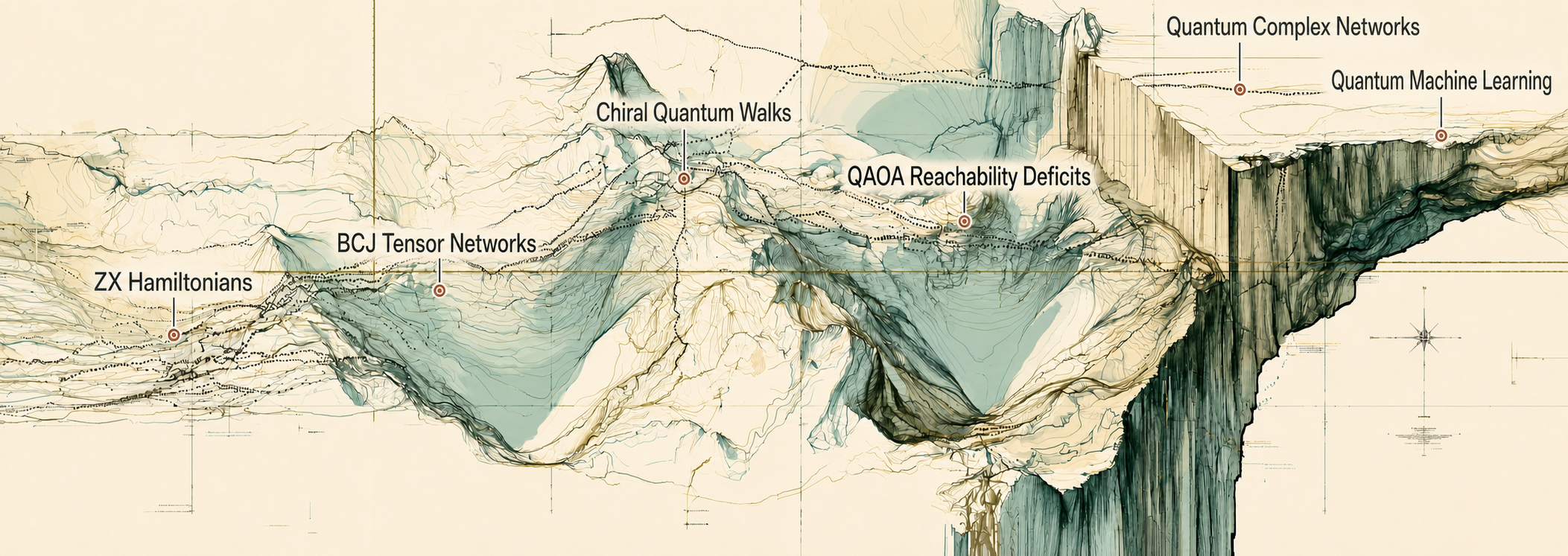
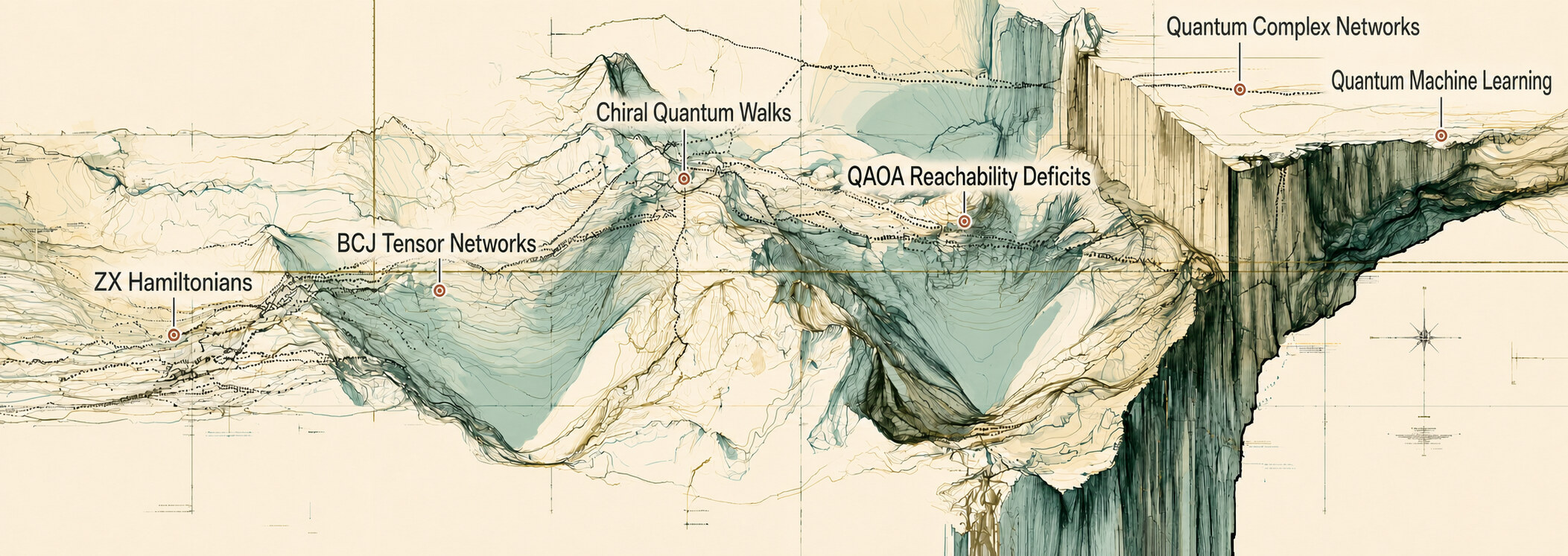
The research program studies computational models between efficient classical simulation and universal quantum computation. It asks how interactions, rules of composition, and the statistical structure of problem-instance families determine what these models can compute. The diagram below groups selected publications by physical model, programming language, and emergent properties.
Le cadre de recherche
Le programme étudie les modèles de calcul situés entre la simulation classique efficace et le calcul quantique universel. Il demande comment les interactions, les règles de composition et la structure statistique des familles d’instances déterminent ce que ces modèles peuvent calculer. Le diagramme ci-dessous regroupe des publications sélectionnées selon le modèle physique, le langage de programmation et les propriétés émergentes.
Which interactions and ground states can encode logic or universal computation?
Which compositional rules turn physical structure into a language for calculation?
What average-case behavior and large-system structure become visible?
Quelles interactions et quels états fondamentaux peuvent encoder la logique ou le calcul universel ?
Quelles règles de composition transforment une structure physique en langage de calcul ?
Quels comportements moyens et quelles structures de grande taille deviennent visibles ?
Research record
Concepts and frameworks reported in Biamonte’s single- and coauthored publications include ground-state spin logic; categorical tensor-network states, including a construction for representing arbitrary n-qubit states using specified tensor building blocks and a demonstration that AND, COPY, and |−⟩ tensors can realize a computationally universal gate set; continuous-time chiral quantum walks obtained by breaking time-reversal symmetry; spectral-entropy measures for comparing complex networks; reachability deficits in QAOA; and training saturation in layerwise QAOA.
The cited publications establish QMA-completeness for two restricted families of 2-local Hamiltonians containing one-local X/Z terms and two-local XX/ZZ or ZX/XZ couplings; perturbative-gadget constructions used to establish restricted XX/ZZ and ZX/XZ models and to simulate effective YY couplings using XX/ZZ-type interactions (Biamonte–Love 2008; Cao et al. 2015); gate-complexity and resource analyses for quantum simulation of electronic-structure Hamiltonians; tensor-network representations of polynomial local-unitary invariants, with matrix-product states as a principal example; polynomial-time contraction for counting problems whose tensor-network expressions contain O(log n) COPY tensors with polynomially bounded fan-out; a graphical calculus relating the Liouville, Choi, process-matrix, Kraus, and system–environment representations of completely positive maps; precise universality conditions for a class of one-dimensional QAOA constructions, with extensions to specified graph and hypergraph cost Hamiltonians; and two objective-function constructions establishing the computational universality of variational quantum computation.
Biamonte also coauthored experimental studies of photonic quantum chemistry in 2010, chiral quantum walks in 2016, and quantum adversarial learning with superconducting qubits in 2022. His publications also include work on quantum complex networks through research on spectral-entropy measures and the synthesis article Complex Networks from Classical to Quantum, and on quantum machine learning through the 2017 review and the 2022 adversarial-learning study.
Parcours de recherche
Les concepts et cadres présentés dans les publications de Biamonte à auteur unique et en collaboration comprennent la logique de spin à l’état fondamental ; les états catégoriques de réseaux de tenseurs, comprenant une construction permettant de représenter des états arbitraires de n qubits au moyen de briques tensorielles spécifiées et une démonstration que les tenseurs AND, COPY et |−⟩ peuvent réaliser un ensemble de portes computationnellement universel ; les marches quantiques chirales en temps continu obtenues en brisant la symétrie d’inversion du temps ; les mesures d’entropie spectrale pour comparer les réseaux complexes ; les déficits d’accessibilité dans le QAOA ; et la saturation de l’entraînement dans le QAOA couche par couche.
Les publications citées établissent la QMA-complétude de deux familles restreintes d’hamiltoniens 2-locaux comportant des termes X/Z 1-locaux et des couplages XX/ZZ ou ZX/XZ 2-locaux ; des constructions de gadgets perturbatifs utilisées pour établir des modèles restreints XX/ZZ et ZX/XZ et pour simuler des couplages YY effectifs au moyen d’interactions de type XX/ZZ (Biamonte–Love 2008 ; Cao et al. 2015) ; des analyses de complexité en portes et de ressources pour la simulation quantique d’hamiltoniens de structure électronique ; des représentations par réseaux de tenseurs d’invariants polynomiaux sous transformations unitaires locales, les états de produits matriciels constituant un exemple principal ; la contraction en temps polynomial de problèmes de comptage dont les expressions en réseaux de tenseurs contiennent O(log n) tenseurs COPY avec un fan-out borné polynomialement ; un calcul graphique reliant les représentations de Liouville, de Choi, par matrice de processus, de Kraus et système–environnement des applications complètement positives ; des conditions précises d’universalité pour une classe de constructions QAOA unidimensionnelles, avec des extensions à des hamiltoniens de coût spécifiés sur des graphes et des hypergraphes ; et deux constructions de fonctions objectif établissant l’universalité computationnelle du calcul quantique variationnel.
Biamonte a également cosigné des études expérimentales sur la chimie quantique photonique en 2010, les marches quantiques chirales en 2016 et l’apprentissage adversarial quantique avec des qubits supraconducteurs en 2022. Ses publications comprennent également des travaux sur les réseaux complexes quantiques, notamment les mesures d’entropie spectrale et l’article de synthèse Complex Networks from Classical to Quantum, ainsi que sur l’apprentissage automatique quantique, notamment la revue de 2017 et l’étude de 2022 sur l’apprentissage adversarial.
One sentence
Jacob Biamonte studies computational models between efficient classical simulation and universal quantum computation.
Short biography
Jacob Biamonte is Professor and Chairholder of the MEIE Principal Research Chair in Quantum Computing. He studies computational models between efficient classical simulation and universal quantum computation. Concepts and frameworks associated with his work include ground-state spin logic, categorical tensor-network states, continuous-time chiral quantum walks, spectral-entropy measures for comparing complex networks, reachability deficits in QAOA, and training saturation in layerwise QAOA.
Full biography
Jacob Biamonte’s research asks what minimal structure enables quantum computation. He is Professor and Chairholder of the MEIE Principal Research Chair in Quantum Computing.
He studies computational models between efficient classical simulation and universal quantum computation. He examines how interactions, rules of composition, and the statistical structure of problem-instance families determine what these models can compute.
Concepts and frameworks associated with his work include ground-state spin logic, categorical tensor-network states, continuous-time chiral quantum walks, spectral-entropy measures for comparing complex networks, reachability deficits in QAOA, and training saturation in layerwise QAOA. His publications also include work on quantum complex networks and quantum machine learning, including research papers and synthesis articles. He also coauthored experimental studies of photonic quantum chemistry, chiral quantum walks, and quantum adversarial learning.
Biamonte earned a PhD in Computer Science from the University of Oxford and a Doctor of Science in Mathematical Physics from the Moscow Institute of Physics and Technology. He is a Fellow of the Institute of Physics and a recipient of the USERN Medal in Formal Sciences.
Une phrase
Jacob Biamonte étudie les modèles de calcul situés entre la simulation classique efficace et le calcul quantique universel.
Biographie courte
Jacob Biamonte est professeur et titulaire de la Chaire principale du MEIE en informatique quantique. Il étudie les modèles de calcul situés entre la simulation classique efficace et le calcul quantique universel. Les concepts et cadres associés à ses travaux comprennent la logique de spin à l’état fondamental, les états catégoriques de réseaux de tenseurs, les marches quantiques chirales en temps continu, les mesures d’entropie spectrale pour comparer les réseaux complexes, les déficits d’accessibilité dans le QAOA et la saturation de l’entraînement dans le QAOA couche par couche.
Biographie complète
Les recherches de Jacob Biamonte demandent quelle structure minimale permet le calcul quantique. Il est professeur et titulaire de la Chaire principale du MEIE en informatique quantique.
Il étudie les modèles de calcul situés entre la simulation classique efficace et le calcul quantique universel. Il examine comment les interactions, les règles de composition et la structure statistique des familles d’instances déterminent ce que ces modèles peuvent calculer.
Les concepts et cadres associés à ses travaux comprennent la logique de spin à l’état fondamental, les états catégoriques de réseaux de tenseurs, les marches quantiques chirales en temps continu, les mesures d’entropie spectrale pour comparer les réseaux complexes, les déficits d’accessibilité dans le QAOA et la saturation de l’entraînement dans le QAOA couche par couche. Ses publications comprennent également des travaux sur les réseaux complexes quantiques et l’apprentissage automatique quantique, notamment des articles de recherche et de synthèse. Il a également cosigné des études expérimentales sur la chimie quantique photonique, les marches quantiques chirales et l’apprentissage adversarial quantique.
Biamonte a obtenu un doctorat en informatique de l’Université d’Oxford ainsi qu’un Doctor of Science en physique mathématique du Moscow Institute of Physics and Technology. Il est Fellow de l’Institute of Physics et lauréat de la médaille USERN en sciences formelles.
In his words
Dans ses mots
“There should be these wonderful patterns that classical computers cannot detect … That’s the exciting future that doesn’t exist yet.”
At a glance
En bref
Photography
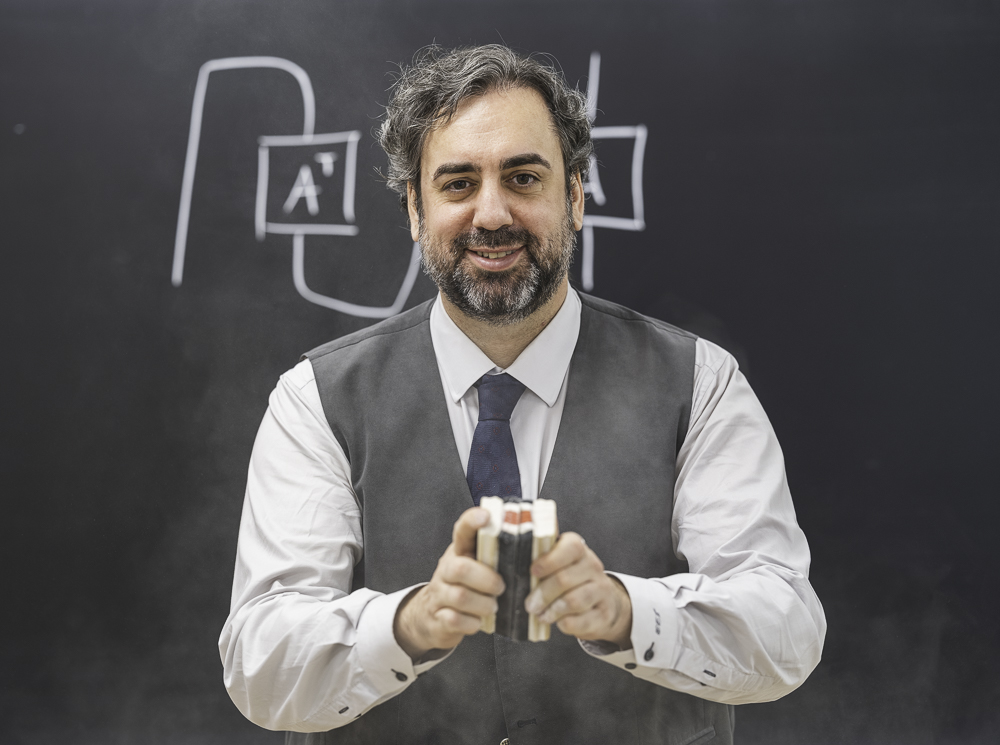
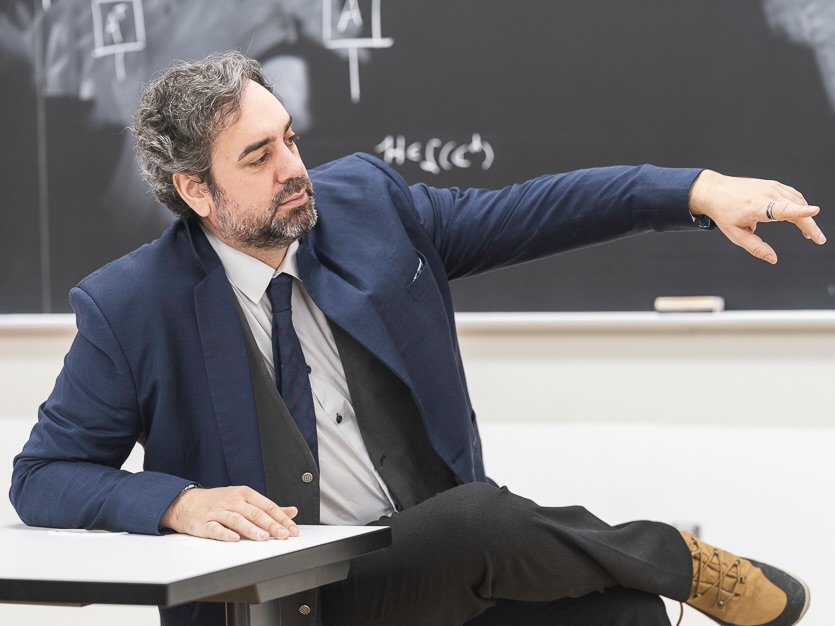
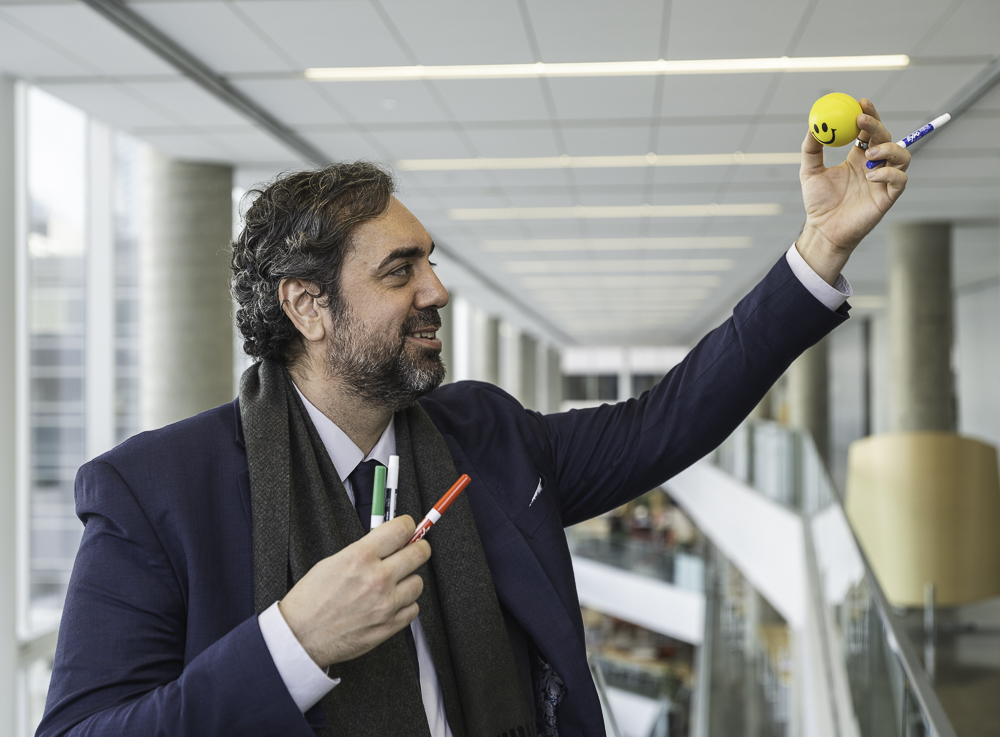
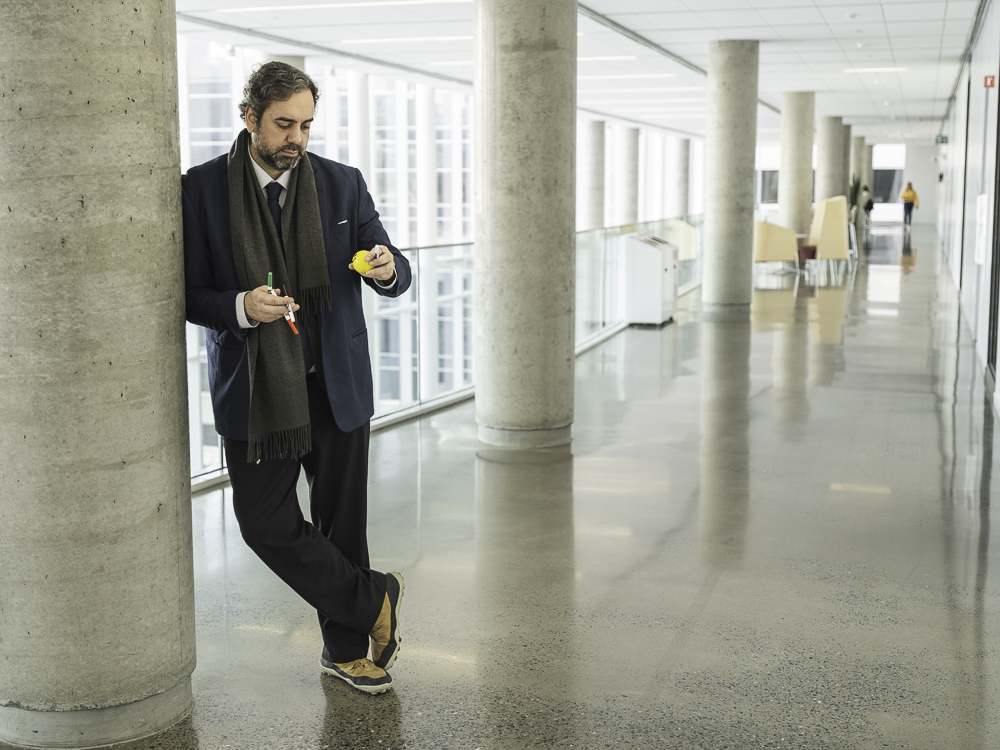
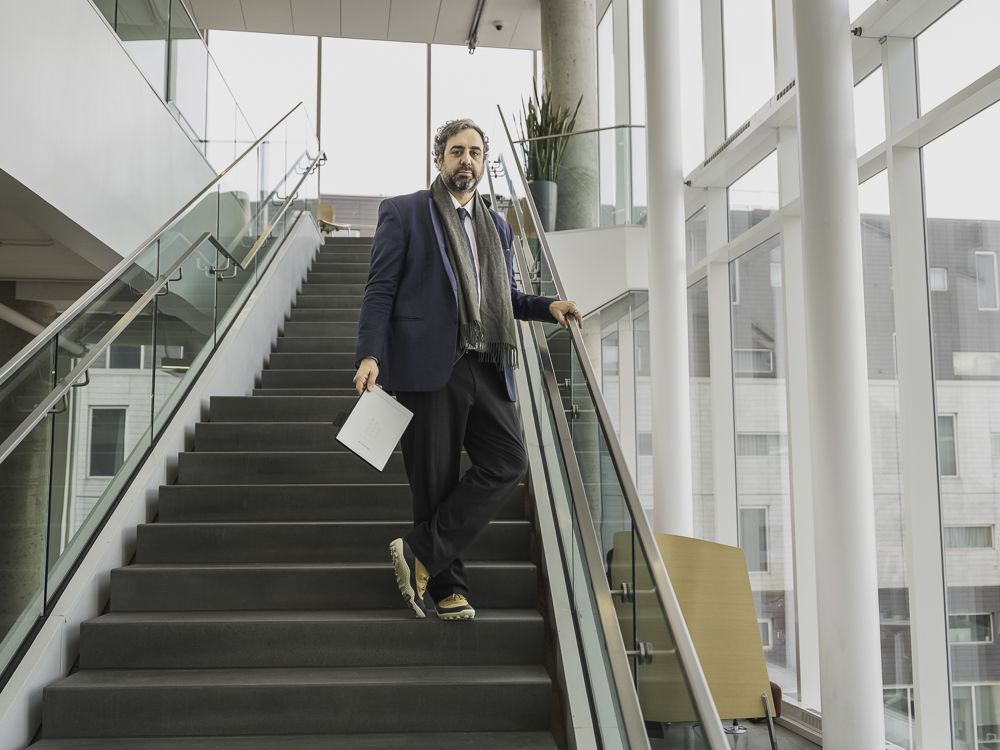
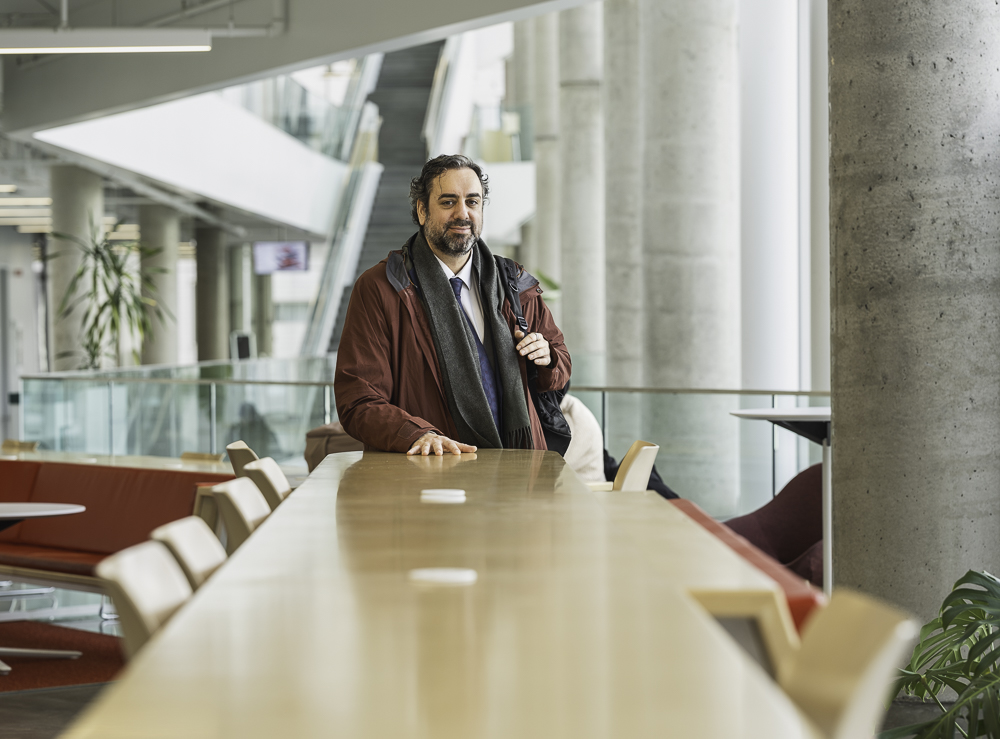
These high-resolution photographs may be used for editorial and institutional coverage of Jacob Biamonte. Credit for all photographs: Vincent Lemelin. Select an image to download the original file.
Photographies
Ces photographies en haute résolution peuvent être utilisées pour la couverture éditoriale et institutionnelle de Jacob Biamonte. Crédit pour toutes les photographies : Vincent Lemelin. Sélectionnez une image pour télécharger le fichier original.
Media contact
Communications Advisor
École de technologie supérieure (ÉTS)
Université du Québec
Montréal, Québec, Canada
Contact médias
Conseillère en communication
École de technologie supérieure (ÉTS)
Université du Québec
Montréal, Québec, Canada